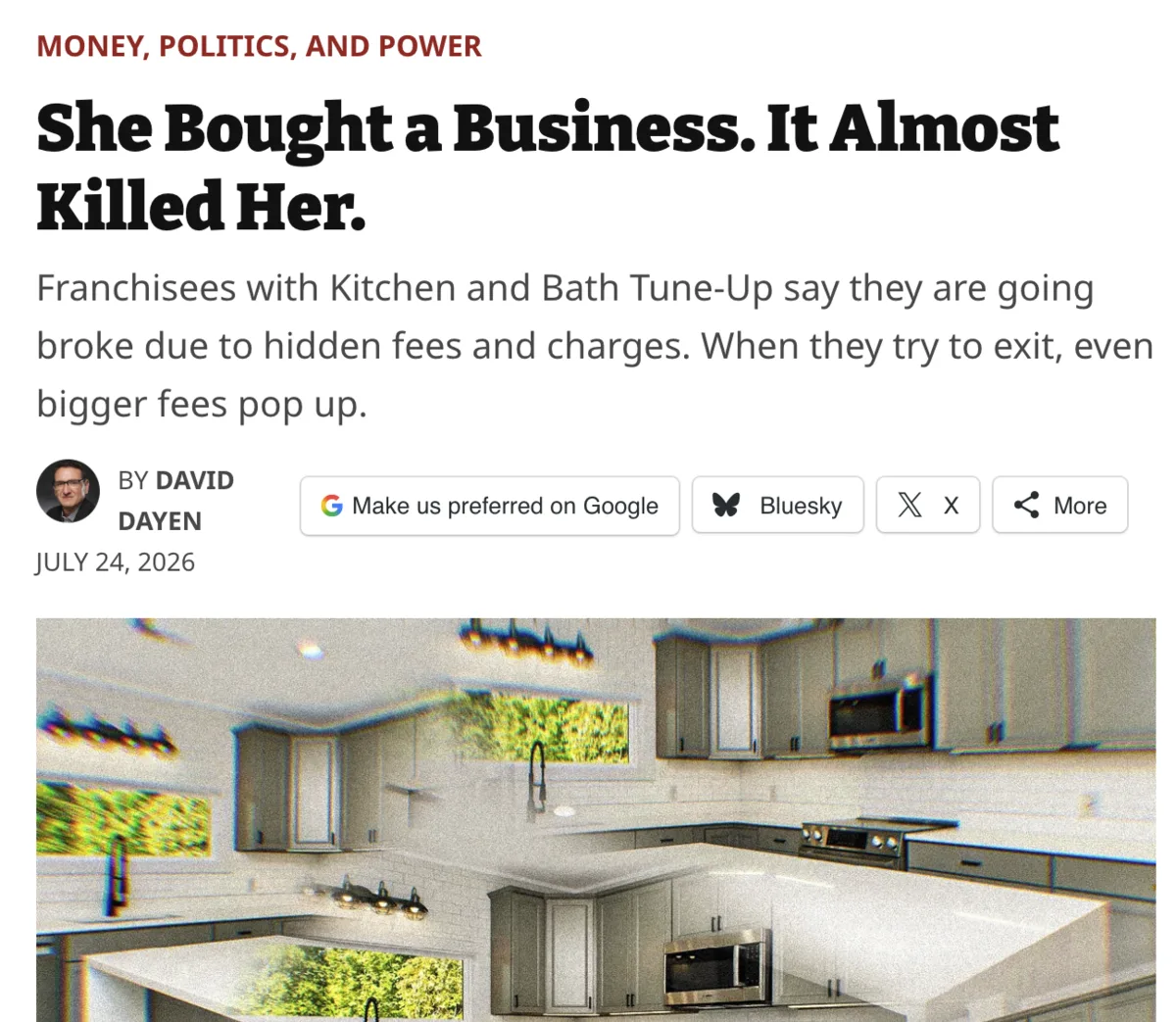
We Might Be The Most Hated Newsletter in Franchising, For This One Reason...
It starts with a 400-page legal document, a quarter-million-dollar decision, and an industry that makes billions when you do not read the fine print.
The American Prospect, July 24, 2026
Meet Mrs. Hagenau,
Carola Hagenau did everything the franchise industry tells you to do.
She researched the brand. She talked to existing franchisees. She attended Discovery Day and asked the hard questions. She invested $200,000 from her 401(k) and an SBA loan into a Bath Tune-Up franchise in Castle Rock, Colorado.
Within a year, she was a top-five producer in the entire system, generating nearly $1 million in annual revenue and earning multiple company awards.
She never turned a profit. Not once.
The rebates and discounts on materials that should have flowed to her store were flowing to the parent company instead. By the time she figured it out, she was $550,000 in the hole. She filed Chapter 13 bankruptcy. Her children stopped speaking to her.
Three months after she walked away from the franchise, she launched an independent renovation company and hit $500,000 in sales. While actually earning income this time.
The franchise did not fail because Carola was bad at the business. She was one of the best operators in the system and the numbers proved it.
The franchise failed because the Franchise Disclosure Document, a 200-plus page legal file she received exactly 14 days before signing, contained warning signs she did not know how to read.
She is not alone. She joined 20 other franchisees from the same system in a lawsuit against the franchisor.
And that is the part nobody in the franchise industry is eager to tell you.
The System That Sells You a Franchise
When you start researching franchises, you enter a system that was built to get you to sign.
You fill out an online form on one of those "find the right franchise" websites. Within 48 hours, four brand salespeople and two "free franchise consultants" are calling your phone.
The consultants seem independent. They ask thoughtful questions about your goals, your budget, your lifestyle. They match you with brands that seem to fit everything you are looking for.
What nobody mentions is how those consultants get paid. They earn 40 to 50 percent of the first-year franchise fee from the franchisor. On a typical $50,000 franchise fee, that is $20,000 to $25,000 per deal. They are not working for you. They are working for the brands that pay the highest commissions.
And those brands represent only about 100 to 150 options out of roughly 4,000 active franchise systems in the United States. Entire categories of well-run, conservatively-priced franchises with lower commission structures are invisible to anyone who found their advisor through a website form.
One industry insider, a former franchise broker himself, confirmed the math from the inside. A broker collects up to $35,000 per closed deal. A lead referrer who simply passed your name along gets around $3,500 just for the introduction. Everyone from the rankings website to the "consultant" is pushing you to buy what pays them the most.
The franchise trade press is no better. Publications like Franchise Times and Franchise Update Media are funded by franchisor advertising. Their rankings and features read like promotional material because that is exactly what they are. Even the satisfaction surveys that rank the "best" franchises charge the franchisors to participate. A brand that does not pay does not get measured.
This is a $921 billion industry with 845,000 active establishments, and nearly every source of information available to a first-time buyer is funded by the people selling franchises.
The Document You Are Supposed to Read in 14 Days
Meanwhile, you are holding something called a Franchise Disclosure Document, or FDD.
The FDD is a legal disclosure that every franchisor in America must provide to a prospective buyer at least 14 days before signing a franchise agreement. Federal law requires it. It runs anywhere from 200 to 800 pages. It is written by franchise attorneys in legal language. It contains 23 required sections called "Items" that cover everything from litigation history to earnings data to termination clauses.
And here is the part that should stop you cold.
Item 19 is the section where a franchisor tells you what existing franchisees actually earn. Item 19 is optional. Many franchisors leave it blank. That means you can invest $250,000 or more into a business without the franchisor ever disclosing what the people already running it actually make. Among the franchisors who do fill out Item 19, only 56 percent include expense information, and only 32 percent show a full profit-and-loss statement. The rest show revenue numbers that sound impressive until you remember that revenue is not profit.
Item 20 tracks how many franchisees opened, closed, or transferred their locations over the past three years. This section is required. But the way franchisors categorize closures, transfers, and reacquisitions makes it nearly impossible for a regular person to tell whether a system is growing or quietly hemorrhaging operators. A franchise that opened 50 new locations last year looks healthy until you notice that 38 closed and 22 were "transferred" in the same period.
The FDD was designed to satisfy federal regulators. It was not designed to inform you.
Most buyers receive this document, skim the first dozen pages, attend Discovery Day, and sign. The pages that actually predict whether they will make money or lose everything are buried hundreds of pages in, written in language that takes a franchise attorney to decode.
You have 14 days with a document like this. Fourteen days to decide whether you are going to bet $250,000 of your family's savings, your retirement account, or your SBA loan on what is inside it.
Your Two Options (And Why Neither One Works)
Right now, a franchise buyer who wants expert help reading the FDD has two choices.
Option one is a franchise attorney. A flat-fee FDD review runs $1,500 to $3,000 for a single document. If you want the attorney to negotiate terms in the franchise agreement, the number climbs past $5,000. Hourly rates run $300 to $650, and once correspondence begins, costs escalate in ways that are hard to predict. If you are comparing three brands, which you should be, you are looking at $4,500 to $9,000 in legal fees before you have signed anything.
Option two is one of the growing number of AI-powered analysis tools. You upload the 400-page PDF and make a $250,000 decision on a robotic summary with no real investigation done.
What AI gives you is a faster way to read a long document. What it does not give you is the judgment to know when the document is misleading you.
What Franchise Intelligence Actually Looks Like
There is a different approach.
FranchiseFinePrint is a weekly newsletter that publishes one independent FDD teardown every single week. Each teardown is a full financial forensic analysis of a single franchise brand, written in plain English for the person thinking about buying one.
You are not getting a summary or a letter grade. You are getting a forensic teardown.
Here is what that means in practice.
We start with the FDD itself, all 200 to 800 pages of it. We give you the actual costs, the traps to watch out for, and the success rate in the first 10 sentences. But we do not stop there, because the FDD is only part of the picture.
We pull SBA 7(a) loan charge-off data for the brand. The SBA (Small Business Administration) is the federal agency that backs the loans most franchise buyers use to fund their purchase. When those loans go bad, the SBA records the charge-off. That data is public, and it tells you something no FDD is required to disclose. It tells you how many buyers of this specific franchise defaulted on their federal loan. This is the same data the SBA itself uses to decide which franchises qualify for government-backed lending. If the SBA's own numbers say a brand is risky, that is worth knowing before you sign.
We analyze Item 20 exit patterns. Not just how many units closed, but the ratio of closures to openings, the transfer rate (which often signals owners who are trying to escape), and the year-over-year trend line. A franchise that opened 50 new locations last year sounds impressive until you see that 38 closed and 22 were "transferred" during the same period. We show you what those numbers actually mean.
We model real costs. Not the initial investment range the franchisor prints in Item 7, but the actual all-in cost. That includes build-out overruns (which average 34 percent above the franchisor's estimates), working capital during the 12-to-24-month window before most locations reach profitability, ongoing royalties and marketing fees (typically 4 to 12 percent of gross revenue, not profit), and the mandatory renovation costs that hit every 5 to 7 years. That $250,000 initial investment is often $335,000 or more once you account for the costs the FDD underplays.
We read the fine print that determines whether you can leave. Franchise agreements typically lock owners into 10-year terms with non-compete clauses lasting up to 3 years after termination. Transfer fees run $5,000 to $25,000, and the franchisor usually reserves a right of first refusal on any sale. Some agreements allow the franchisor to prevent you from closing a money-losing location and charge future royalties or liquidated damages if you try to walk away. We translate every one of those provisions from legal language into plain English so you know exactly what you are agreeing to before you agree to it.
We check territory protection. Does your "exclusive territory" actually protect you? Or does the agreement include carve-outs for online sales, delivery, catering, co-branding, or alternative distribution channels that let the franchisor compete directly with your location?
And we do all of this without taking a single dollar from any franchisor, franchise broker, or franchise sales organization.
FranchiseFinePrint is 100 percent reader-funded. You are the customer, not the franchisor, not the broker, not the trade press, and not the "free" consultant.
That is the same model that built billion-dollar financial newsletter companies. The analysis is only valuable if the reader trusts it, and the reader can only trust it when the money comes from them and nobody else.
What a Weekly Teardown Puts in Your Hands
Every week, your FFP teardown arrives in your inbox. Here is what you will find inside each one.
The real cost of entry, not just the franchise fee.
Every teardown breaks down the total investment including the line items franchisors bury in Item 7 that most buyers skip right past. You will see what the franchisor estimates, what it actually costs based on comparable builds, and exactly where the overrun risk hides.
What existing franchisees actually earn, or what the franchisor is hiding by leaving that section blank.
When earnings data is present, we show you what the numbers mean in real dollars after royalties, marketing fees, and operating costs. When the earnings section is missing, we explain what that silence tells you about the brand.
The SBA charge-off rate for the brand.
This is the number your franchise consultant will never bring up, because in many cases it directly contradicts the "proven system" sales pitch. Some brands with glossy marketing materials and enthusiastic Discovery Day presentations have charge-off rates that would give a bank examiner serious pause.
Exit trap analysis.
Can you sell your franchise if it is not working out? Can you close it? What happens to your non-compete if the franchisor terminates your agreement instead of the other way around? These answers are buried in Items 15, 16, and 17 of the FDD, and most buyers never read them until it is too late to do anything about it.
Territory protection reality check.
We show you exactly what "exclusive territory" means in the specific language of the agreement you will be signing, not in the general terms the sales team uses during Discovery Day.
Year-over-year outlet trends from Item 20.
Is the system actually growing, or is it just replacing departed franchisees with new ones at the same rate? The raw numbers tell one story. The ratios tell another.
Cross-brand comparison.
Because you are reading a new teardown every week across different industries and investment levels, you build a reference library that no single-brand FDD report can provide. By week ten, you will have a clearer picture of the franchise market than most franchise brokers develop in years of selling.
And every single number in every teardown comes with a receipt, whether that is a page in the FDD, the SBA data set, or the public record. There are no unsourced claims and no proprietary algorithms that spit out a mystery score. Just the math, the documents, and what they actually say.
In case Carola's story sounds like a worst-case exception, here are two more.
Spray Foam Genie, the "semi-absentee" franchise model.
One franchisee invested $350,000 to get started, then poured over $700,000 of personal savings into the venture. Only one crew was operating, and it was not profitable. Of roughly 80 franchisees in the system, only four reported any profitability at all. The "semi-absentee" model, which brokers had promoted as requiring "only 2 hours per month" of owner involvement, turned out to require full-time attention and unlimited cash.
Xponential Fitness, the largest franchise enforcement case in FTC history.
In March 2026, the Federal Trade Commission secured a $17 million settlement plus an additional $22.75 million in relief for 509 franchisees of Club Pilates, YogaSix, and other Xponential brands. The FTC found that the company had misrepresented opening timelines, hidden the CEO's fraud lawsuits from disclosure documents, omitted the names of operators whose studios had closed, and provided outdated contact information that prevented prospects from checking turnover rates. Average initial fee was $45,000 per studio, with 10-year agreements.
These are not rare stories. These are the stories that do not make it into the franchise trade press, because the franchise trade press is funded by the companies doing this. We find them by scraping Reddit groups, search Twitter threads, and dozens of other sources.
What You Would Pay Anywhere Else
A franchise attorney$1,500 to $3,000to review one FDD. For three brands, you are looking at $4,500 to $9,000.
Franchise Grade$199for a single-brand Report Card, from one of the most recognized FDD analysis services.
ClearlyFDD$99per brand for an AI-assisted report.
Every one of those services gives you a snapshot. A single report on a single brand on the day you bought it. No ongoing analysis. No weekly intelligence. No cross-brand context that builds over time into a franchise research library.
FranchiseFinePrint delivers a new independent teardown every week for the entire year. Fifty-two brands analyzed with SBA charge-off data, exit rate tracking, real cost modeling, and plain-English translation of the legal provisions that determine whether you will make money or lose everything.
The price is$79 per year
That works out to $1.52 per week. Less than a gas station coffee. Less than a single page of a franchise attorney's hourly bill. Less than the parking fee at most Discovery Day events.
You are about to make a decision that will cost you $250,000 or more. The people advising you on that decision earn $20,000 to $41,000 when you sign. The publication that earns $79 when it tells you the truth is the cheapest insurance policy you will ever buy.
Try It for 30 Days. If It Is Not Worth It, You Pay Nothing.
Subscribe to FranchiseFinePrint and read the teardowns for a full 30 days. Dig into the SBA data, compare the brands, and pull up the receipts on the numbers.
If you do not believe the analysis is worth far more than $79 for an entire year of weekly franchise intelligence, let us know and you will receive a full refund. No questions asked. No hoops to jump through.
We can offer this guarantee because the math behind it is simple. If even one teardown steers you away from a $250,000 mistake, or reveals an exit trap you would have missed on page 347 of the FDD, or shows you that a brand's SBA charge-off rate tells a different story than its Discovery Day presentation, you will never want to cancel. The $79 will feel like the best money you have ever spent.
Can't I just upload the FDD to ChatGPT or Claude and get the same analysis?
You can upload the document, and the AI will summarize it for you. It will miss the significance of what it reads, because it does not cross-reference the FDD against SBA loan performance data. It does not model real costs based on comparable build-outs in your market. It does not know which termination clauses are standard and which are predatory, because it has no baseline for comparison across hundreds of FDDs. AI summarizes documents. FranchiseFinePrint analyzes businesses. Anyone can put a long PDF through a chatbot. That is not franchise intelligence.
I already have a franchise consultant helping me for free.
Ask your consultant one question. "Who pays you, and how much?" If the answer is anything other than "you pay me directly," then your consultant works for the franchisor. They earn 40 to 50 percent of the first-year franchise fee per deal. That is not a criticism of your consultant as a person. It is a structural conflict of interest that means they are financially motivated to steer you toward brands that pay them the highest commissions, not brands that perform the best for the people who actually operate them.
How is a newsletter going to help me with a $250,000 decision?
It will show you what the FDD actually says, in language you can understand, backed by numbers you can verify. It will show you SBA loan performance data that your broker has no reason to mention. It will show you exit traps and cost overruns that only appear when you know where to look in the document. And it will build you a cross-brand reference library that lets you compare franchise opportunities the way a sophisticated institutional investor would, not the way a first-time buyer stumbling through Google search results does.
$79 seems too cheap for serious analysis. What is the catch?
The catch is we are independent. We answer only to you. We stay independent by keeping the price accessible enough that thousands of franchise researchers can subscribe at $79 per year. The volume model is what makes the independence possible. And the independence is what makes the analysis trustworthy. But you're welcome to send us more money if you want too 😁
The Decision in Front of You
Right now, thousands of people are doing exactly what you are doing.
They are googling franchise opportunities. They are filling out inquiry forms. They are downloading FDDs they do not fully understand. They are talking to consultants who seem helpful and knowledgeable, and who earn $20,000 or more when the deal closes.
Some of them will invest $250,000 and build businesses that change their lives for the better. Some of them will invest $250,000 and lose everything they have saved. The difference between those two outcomes almost always comes down to what they understood about the franchise before they signed.
For $79 per year, FranchiseFinePrint makes sure you understand.
The Weekly Teardown
$79 a year
A new independent FDD teardown every week, fifty-two brands a year
SBA charge-off data, exit trap analysis, real cost modeling, and territory checks in every issue
Full refund within 30 days
CHECKOUT COMING SOON
The secure order form goes here.
$79 a year. Renews yearly. Cancel any time by email. It is being connected now. Questions in the meantime go to support@byoupublishing.com.
P.S. Every single week, a new franchise brand gets the full forensic treatment. SBA loan data, real cost modeling, exit trap analysis, territory protection audit, and plain-English translation of the FDD provisions that most buyers never read until it is too late. Fifty-two brands per year for $79. There is nothing else like it in the franchise industry, because nobody else is paid by the reader.
P.P.S. The franchise industry is a $921 billion machine with 845,000 active locations. It has its own trade press, its own conferences, its own ranking systems, and its own advisory network. Nearly all of it is funded by the people who sell franchises. FranchiseFinePrint exists because the people who buy franchises deserve at least one source of intelligence that works for them.